 EN

What Natural Gas Processing Plants Do and Why They Matter
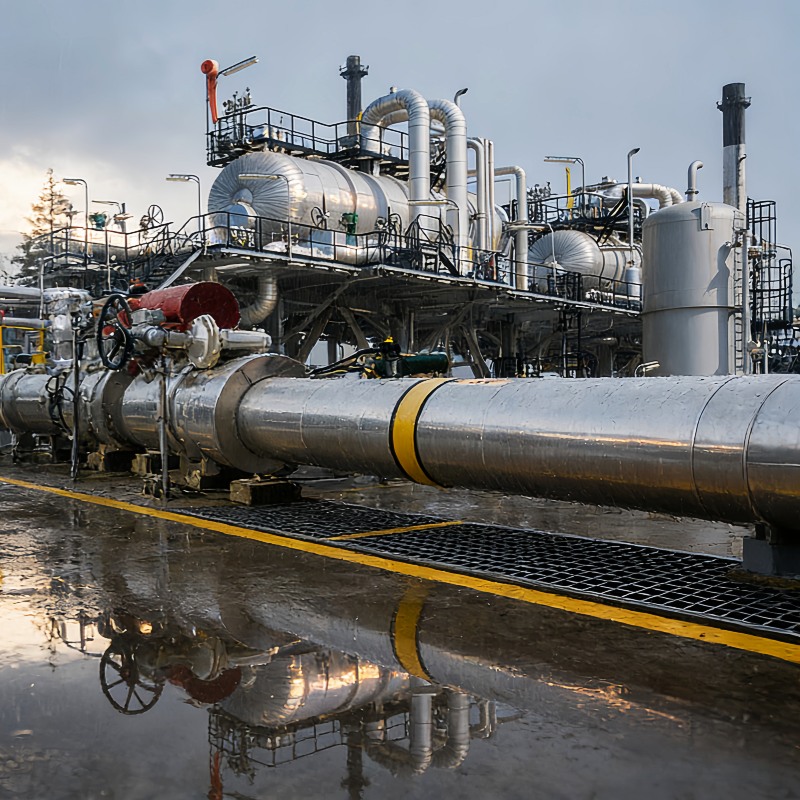
Raw natural gas from wellheads is not the same product that utilities deliver to homes and power plants. Natural gas processing plants transform this raw stream into clean, dry, pipeline-quality methane while recovering valuable natural gas liquids (NGLs) such as ethane, propane, and butanes. Raw gas often contains water vapor, hydrogen sulfide, carbon dioxide, and heavier hydrocarbons—impurities that can corrode pipelines, form ice-like hydrates at low temperatures, or reduce heating value. Without processing, these contaminants risk infrastructure damage, operational hazards, and noncompliance with pipeline specifications. Plants receive untreated gas via gathering systems, remove impurities, and deliver specification-grade gas through tailgates into intra- and inter-state pipeline networks. They also separate NGLs for petrochemical feedstocks and fuel markets. This midstream role is essential: pipeline operators enforce strict limits on specific gravity, water content, pressure, and energy content before accepting gas for long-distance transport. Global natural gas production exceeds 4 trillion cubic meters annually—and much of it requires treatment, dehydration, and separation before distribution. By stabilizing composition, these facilities protect pipeline integrity, minimize flaring, and significantly increase the economic value of gas production. In major producing regions, integrated processing and petrochemical operations make them foundational to both reliable energy supply and industrial feedstock availability.
Core Stages of Natural Gas Processing in Modern Plants
Raw natural gas entering processing plants typically contains water vapor, carbon dioxide, hydrogen sulfide, and heavier hydrocarbons. Modern facilities remove these impurities sequentially to produce pipeline-quality dry methane and marketable NGLs. Two foundational stages define this workflow: acid gas removal with dehydration, and hydrocarbon dew point control with NGL recovery.
Acid Gas Removal and Dehydration
Acid gas removal strips hydrogen sulfide and carbon dioxide using amine treating, membranes, or other technologies. Dehydration then removes residual water vapor to prevent hydrate formation—which can block pipelines and accelerate corrosion. While single-stage membrane units may lose more than 15% of methane in the permeate stream, multi-stage designs improve recovery efficiency. These steps are critical for protecting downstream equipment and meeting environmental and pipeline quality standards.
Hydrocarbon Dew Point Control and NGL Recovery
After dehydration, the gas undergoes dew point control to condense heavier hydrocarbons and prevent liquid dropout during transmission. Cryogenic separation—common in modern plants—cools the gas to approximately –120°F (–84°C) using expansion turbines, separating methane from ethane, propane, butanes, and natural gasoline. This stage increases heating value, generates NGL revenue, and ensures final gas meets pipeline specifications for dryness and hydrocarbon content.
Key Equipment and Technology Used in Natural Gas Processing Plants
Modern natural gas processing plants combine specialized separation systems with digital controls to maximize recovery, maintain product specifications, and minimize downtime. Two equipment groups are especially critical: gas treating and cryogenic recovery systems, and the automation layer that coordinates them.
Amine Treating Units and Cryogenic Separation Systems
Amine treating units remove hydrogen sulfide and carbon dioxide by circulating an aqueous amine solvent through an absorber tower. Rich amine is regenerated with heat, releasing acid gases for sulfur recovery or safe disposal. Proper amine strength and regeneration temperature help prevent foaming and corrosion. After acid gas removal and dehydration, cryogenic separation systems cool the gas using turboexpanders and brazed aluminum exchangers. Ethane, propane, butane, and heavier NGLs condense at distinct temperatures while methane remains gaseous. A demethanizer column then separates the NGL stream, enabling high ethane recovery and precise product fractionation.
Automation, SCADA, and Digital Twin Applications
SCADA (Supervisory Control and Data Acquisition) systems collect real-time data on pressure, temperature, flow, level, and gas composition—supporting alarm management, valve actuation, compressor control, and emergency shutdown. Digital twin applications integrate this data with a dynamic virtual model of the plant. The model simulates feed variability, equipment degradation, and operating scenarios to inform setpoint adjustments and predictive maintenance planning. Advanced analytics further optimize trade-offs between product recovery and compression energy use. Together, these tools improve energy efficiency, reduce unplanned downtime, and enable remote operation—even for geographically dispersed assets.
Regulatory Compliance, Safety, and Environmental Considerations
Operating natural gas processing plants demands layered compliance with air, water, and process safety regulations. In the United States, the Environmental Protection Agency’s (EPA) 2024 methane rule under the Clean Air Act targets routine flaring, leak detection, and repair at processing facilities—projected to cut methane emissions by roughly 58 million tons through 2038. OSHA’s Process Safety Management (PSM) standard and industry-recommended practices guide hazard analysis, mechanical integrity, and personnel training for high-pressure, amine-treating, and cryogenic systems. For sour gas facilities, continuous hydrogen sulfide monitoring and automated emergency shutdown systems are essential safeguards.
Environmental management extends beyond methane. Glycol dehydration vents, amine unit fugitive emissions, and produced water handling often require state-level permits and benzene waste controls under federal air toxics rules. Leading operators deploy optical gas imaging cameras and continuous fenceline monitors to meet quarterly leak detection and repair (LDAR) obligations and avoid enforcement penalties. As the International Energy Agency noted in its 2023 analysis, about 40% of oil and gas methane emissions can be mitigated at no net cost—making proactive compliance economically viable when supported by digital work-order systems. Increasingly, process safety and environmental performance share a unified data foundation, enabling safer, lower-emission operations.
Emerging Trends and Future-Proofing Natural Gas Processing Plants
Natural gas processing plants are evolving toward lower-carbon, higher-resilience operations—without compromising throughput or reliability. Two trends are reshaping design and deployment: carbon capture integration and energy-efficient retrofitting, and modular, scalable plant architectures for remote development.
Carbon Capture Integration and Energy-Efficient Retrofitting
Operators are adding carbon capture units to existing gas processing trains to reduce CO₂ emissions. Post-combustion and pre-combustion capture systems can remove up to 90% of CO₂ before atmospheric release. Energy-efficient retrofits—including heat recovery from compression, advanced solvents, and electric drives—cut fuel consumption and operating costs. These upgrades often qualify for emissions credits and extend the service life of aging infrastructure.
Modular and Scalable Plant Designs for Remote Operations
Modular processing plants use prefabricated, skid-mounted systems that can be rapidly shipped and assembled at remote well sites. This approach lowers capital cost and execution risk. Plants can begin with minimal capacity and scale incrementally as production grows—avoiding costly overdesign. Built-in remote monitoring and automated controls reduce reliance on on-site staff, a key advantage in harsh or isolated environments.
FAQ Section
What are natural gas processing plants?
Natural gas processing plants are facilities that transform raw natural gas from wellheads into pipeline-quality methane by removing impurities and recovering valuable NGLs like ethane and propane.
Why is processing natural gas important?
Processing ensures gas meets pipeline specifications, protects infrastructure, prevents hazards, and increases the economic value of production.
What technologies are used in natural gas processing?
Technologies include amine treating units for impurity removal, cryogenic separation for NGL recovery, and automation systems like SCADA and digital twins for efficiency and predictive maintenance.
How do natural gas plants handle emissions?
Operators comply with regulations like EPA methane rules and use technologies like optical gas imaging cameras and fenceline monitors to reduce emissions.
What are modular gas processing plants?
These are prefabricated systems that can be scaled incrementally at remote sites, reducing costs and execution risks.
Table of Contents
- What Natural Gas Processing Plants Do and Why They Matter
- Core Stages of Natural Gas Processing in Modern Plants
- Key Equipment and Technology Used in Natural Gas Processing Plants
- Regulatory Compliance, Safety, and Environmental Considerations
- Emerging Trends and Future-Proofing Natural Gas Processing Plants
- FAQ Section