 EN
EN

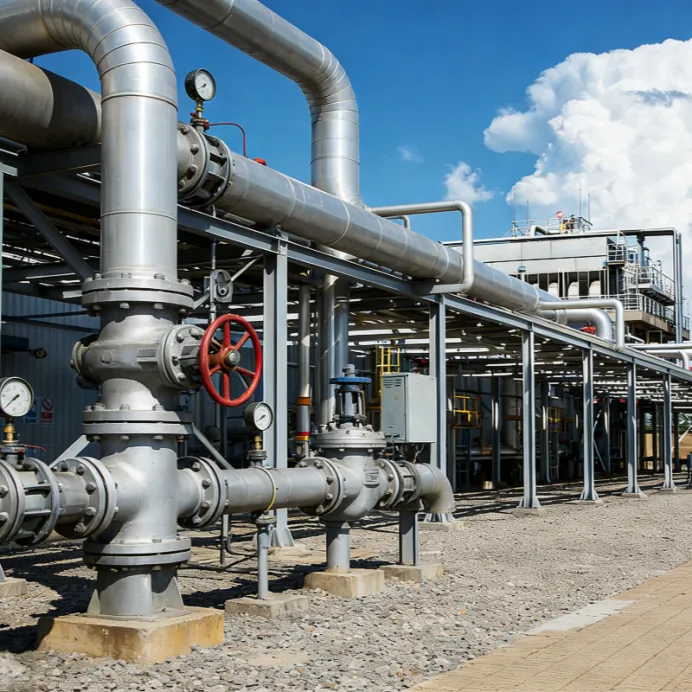
Material Selection and Corrosion Control for Industrial Gas Technology Solutions
Why Standard Carbon Steels Fail in Hydrogen-Blended and High-Pressure Gas Environments
Standard carbon steels are fundamentally unsuited for hydrogen-blended or high-pressure gas service. Hydrogen permeation induces hydrogen embrittlement (HE), triggering unpredictable microcrack propagation. In sour gas environments, pressures above 20 MPa markedly accelerate sulfide stress cracking (SSC). Research shows pipeline systems carrying 10% hydrogen blends suffer up to 60% faster crack growth than those transporting pure natural gas—highlighting a critical gap in legacy material performance.
Alloy Optimization and Electrochemical Protection Strategies for Long-Term System Integrity
To ensure long-term integrity, engineers increasingly specify corrosion-resistant alloys (CRAs) such as duplex stainless steels and nickel-based alloys for high-risk sections. These materials deliver proven resistance to hydrogen-induced cracking, pitting, and stress corrosion—especially under elevated pressure and hydrogen exposure.
For existing carbon steel infrastructure, a layered electrochemical protection strategy is essential:
- Cathodic protection with monitored rectifiers
- Non-metallic internal linings (e.g., epoxy-phenolic coatings)
- Targeted injection of volatile corrosion inhibitors during gas dehydration
The table below compares core corrosion prevention approaches:
| Preventive Measure | Implementation | Key Benefit |
|---|---|---|
| CRAs | New pipeline construction | Eliminates 92% of corrosion-related maintenance |
| Cathodic Protection | Retrofit existing pipelines | Extends service life by 15–20 years |
| Inhibitor Injection | Continuous chemical dosing | Reduces internal corrosion rate by 70% |
| Composite Linings | Pipe interior coating | Blocks hydrogen permeation and mitigates HE |
When implemented cohesively, these measures uphold ASME B31.3 design and pressure integrity requirements. Field data from well-maintained systems confirms 98% operational availability over 30-year lifespans.
Advanced Integrity Management for Aging and Next-Generation Gas Pipelines
Risk-Based Inspection Frameworks: Integrating Smart Pigging, ILI, and Digital Twin Modeling
Risk-based inspection (RBI) frameworks are now the industry standard for managing both aging assets and next-generation builds. By quantifying failure probability and consequence severity, RBI prioritizes inspection efforts where they yield the greatest safety and reliability impact.
Smart pigging and in-line inspection (ILI) tools deliver high-fidelity data on metal loss, crack geometry, and deformation—forming the empirical foundation for integrity decisions. When integrated into a digital twin model, this data enables dynamic simulation of corrosion progression under real-world operating conditions, accurate remaining-life prediction, and data-driven optimization of inspection intervals.
For industrial gas technology solutions, this integration significantly reduces leak risk and unplanned outages while ensuring compliance with API RP 1160 and ASME B31.8S. Machine learning enhances pattern recognition—detecting early signatures of stress corrosion cracking before conventional methods would flag them. Replacing fixed time-based schedules with condition-based interventions cuts operational costs and extends asset life. Live SCADA sensor inputs continuously update the digital twin, enabling real-time recalibration of risk assessments and rapid response to anomalies.
Regulatory Alignment and Digital Compliance in Industrial Gas Technology Solutions
Navigating NFPA 55, ISO 13623, and PHMSA Part 192 — Key Overlaps and Gaps
Compliance across NFPA 55, ISO 13623, and PHMSA Part 192 demands careful coordination—not duplication. All three require robust material selection, leak detection, and documentation of integrity management. Yet critical gaps persist: NFPA 55 applies strictly to storage and handling facilities—not transmission pipelines—while ISO 13623 lacks prescriptive guidance for hydrogen service, particularly around embrittlement thresholds and CRA qualification. PHMSA Part 192 governs U.S. interstate pipelines but does not address blended gas composition limits or digital twin validation protocols.
Bridging these gaps requires a unified compliance architecture—one that maps controls to the highest applicable requirement per functional domain, rather than layering overlapping procedures.
The Shift Toward Real-Time Monitoring and Automated Compliance Reporting
Manual audits and periodic reporting are no longer sufficient for modern industrial gas technology solutions. IoT-enabled sensor networks—deployed at compressor stations, metering points, and critical welds—provide continuous, tamper-evident monitoring of pressure, flow, temperature, and fugitive emissions. This real-time telemetry feeds directly into integrated compliance platforms that auto-generate audit-ready reports aligned with PHMSA, ISO, and NFPA recordkeeping mandates.
The result is faster violation detection, reduced administrative overhead, and demonstrable adherence to evolving regulatory expectations—including EPA’s Greenhouse Gas Reporting Program and upcoming EU Hydrogen Backbone regulations. Automated reporting also strengthens EEAT credibility by linking every compliance assertion to timestamped, source-verified sensor data.
Future-Proofing Industrial Gas Pipeline Systems: Hydrogen Blending and Smart Infrastructure
Hydrogen blending introduces two interdependent challenges: accelerated material degradation and heightened system complexity. Hydrogen’s small atomic radius promotes diffusion into susceptible alloys, lowering fracture toughness and increasing susceptibility to cracking—even in some stainless grades previously deemed adequate. Mitigating this demands rigorous, application-specific material compatibility testing—not generic alloy selection—and continuous monitoring of hydrogen concentration, pressure cycling, and temperature gradients.
Simultaneously, smart infrastructure deployment is non-negotiable. Distributed pressure and acoustic emission sensors, coupled with intelligent flow control valves and edge-analytics nodes, transform passive pipelines into responsive systems. These components enable sub-minute leak localization, predictive maintenance triggered by deviation trends—not calendar dates, and adaptive operational responses to changing gas composition or demand profiles.
For industrial gas technology solutions providers, integrating these capabilities isn’t merely strategic—it’s foundational to delivering safe, resilient, and decarbonized energy infrastructure in alignment with global net-zero commitments and tightening regulatory timelines.
FAQ
Why are carbon steels unsuitable for hydrogen-blended gas environments?
Carbon steels fail in hydrogen-blended gas environments due to hydrogen embrittlement and high crack growth rates in sour gas conditions, especially in the presence of pressures above 20 MPa.
What materials are recommended for high-pressure industrial gas pipelines?
Corrosion-resistant alloys (CRAs), like duplex stainless steels and nickel-based alloys, are recommended due to their resistance to hydrogen-induced cracking and stress corrosion.
What is the role of cathodic protection in existing pipelines?
Cathodic protection extends the service life of existing pipelines by 15–20 years, preventing corrosion through electrochemical means.
How do digital twin models improve pipeline integrity management?
Digital twin models use real-time data to simulate corrosion progression, predict pipeline life, and optimize inspection and maintenance schedules, reducing costs and improving reliability.
What are the compliance challenges in industrial gas technology solutions?
Key challenges include aligning requirements across NFPA 55, ISO 13623, and PHMSA Part 192, which have gaps in areas like hydrogen service standards and digital twin validation protocols.
What steps can future-proof industrial gas pipelines?
Future-proofing involves rigorous material testing, smart infrastructure deployment (such as IoT sensors), and adopting real-time monitoring systems to adapt to evolving demands and regulatory standards.
Table of Contents
- Material Selection and Corrosion Control for Industrial Gas Technology Solutions
- Advanced Integrity Management for Aging and Next-Generation Gas Pipelines
- Regulatory Alignment and Digital Compliance in Industrial Gas Technology Solutions
- Future-Proofing Industrial Gas Pipeline Systems: Hydrogen Blending and Smart Infrastructure