 EN
EN

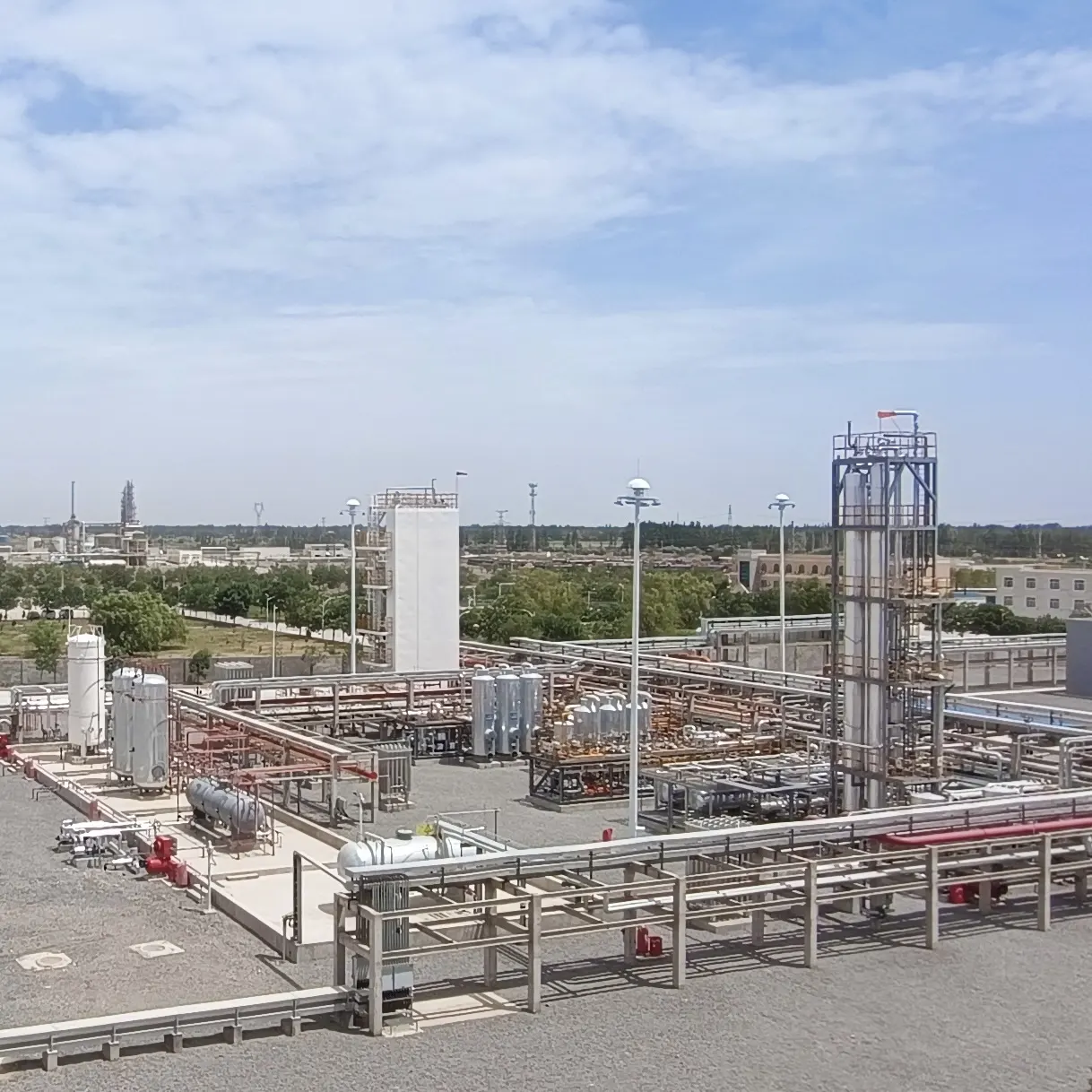
Maximizing NGL Recovery in Natural Gas Processing Plants
Thermodynamic Leverage Points: Cryogenic vs. Absorption-Based Recovery
Processing plants face critical thermodynamic tradeoffs when selecting NGL recovery methods. Cryogenic separation leverages turboexpansion to achieve temperatures below –120°F, condensing ethane and heavier hydrocarbons with 90–95% recovery efficiency. It dominates large-scale operations but demands significant compression energy and high inlet pressures (600 psig). Absorption-based systems using refrigerated solvents operate at milder conditions (–40°F), reducing energy intensity by 30%—yet cap propane recovery at ~85%. Field data shows absorption excels in lean gas streams (<3 GPM), where cryogenic efficiency declines. Advanced hybrid configurations now integrate both: initial absorption for bulk removal followed by cryogenic finishing. This balances CAPEX and OPEX while sustaining >92% overall NGL recovery across variable feed compositions.
Case Study: 22% NGL Yield Increase via Refrigeration Curve Tuning at a Permian Basin Plant
A Permian Basin facility achieved a 22% NGL yield increase—and an 11% reduction in recompression energy—by optimizing its existing cryogenic unit without new capital investment. Engineers recalibrated temperature approach points and implemented three-stage heat exchange in the cold box, tightening temperature differentials from 15°F to 4°F. This enabled deeper ethane recovery while maintaining propane capture above 94%. Turboexpander bypass flows were reconfigured to accommodate 25% wider gas composition swings. The result: $4.2M in annualized value and validation that thermodynamic fine-tuning can deliver near-greenfield performance from brownfield assets.
Energy-Efficient Cryogenic Expansion for Gas Separation
Cryogenic separation remains a cornerstone technology in natural gas processing plants for high-efficiency NGL recovery—especially for ethane and heavier components. It relies on cooling the feed gas below –150°F (–101°C) to condense NGLs while keeping methane gaseous. Turboexpansion drives this cooling and pressure reduction, but it also introduces major energy demands—particularly for downstream recompression. Optimizing expansion itself is therefore one of the highest-leverage opportunities to reduce the plant’s overall energy footprint.
Reducing Compressor Power Demand Through Multi-Stage Turboexpansion
Single-stage turboexpansion subjects the full gas stream to one large pressure drop, generating entropy losses and increasing recompression work. Multi-stage expansion divides the pressure reduction into controlled steps, enabling intermediate heat recovery and minimizing irreversibilities per the Brayton-Joule-Thomson cycle. Two- or three-stage configurations typically cut compressor power demand by 25–40% versus single-stage systems. Crucially, expansion turbine shaft work can often be directly coupled to drive compressors in the same train—boosting net system efficiency without adding external power sources.
Integrating Pre-Cooling to Improve Isentropic Efficiency
Turboexpander isentropic efficiency determines how effectively pressure drop converts to cooling and usable shaft work—and inlet gas temperature strongly influences it. Pre-cooling the gas before expansion lowers its enthalpy, allowing greater NGL condensation at the same pressure ratio—or achieving target separation temperatures with less pressure drop. Effective pre-cooling methods include:
- Propane or mixed-refrigerant chillers, cooling feed gas to ~–40°F (–40°C);
- Gas-to-gas heat exchangers, using cold overhead gas to pre-chill warm incoming feed.
Optimizing pre-cooling duty and temperature approach points routinely lifts expander isentropic efficiency above 85%, directly reducing recompression energy and operating costs. This integration is essential to fully realize the benefits of multi-stage expansion.
Advanced Separation Technologies for Field-Scale NGL Recovery
Supersonic Separators vs. Joule–Thomson Valves: Performance, Flexibility, and Scalability
Selecting the right field-scale separation technology hinges on balancing recovery targets, feed variability, and deployment constraints. Supersonic separators and Joule–Thomson (J-T) valves represent two distinct approaches—each with complementary strengths.
| Dimension | Supersonic Separator | Joule–Thomson Valve |
|---|---|---|
| Recovery rate | Up to 95% for C₃+; enhanced by shock-induced condensation | Typically 50–70%; limited by isenthalpic expansion |
| Pressure drop | Moderate (30–40% of inlet) | Comparable (20–50%, design-dependent) |
| Energy consumption | No rotating parts; minimal parasitic load | Minimal—but may require downstream recompression |
| Turndown ratio | Narrower (60–100% of design flow) | Wider (20–100%) |
| Gas composition adaptability | Sensitive to liquid loading and solids | Robust across fluctuating inlet conditions |
| Footprint | Compact, skid-mounted (~30% smaller than equivalent J-T system) | Larger due to separator and heater requirements |
| Modularity & cost | Higher upfront cost; scalable via series addition | Lower initial investment; scales linearly with parallel valves |
Supersonic separators deliver superior recovery and space efficiency—ideal for greenfield projects with stable, clean gas. J-T valves provide operational flexibility and lower capital risk—making them well-suited for brownfield retrofits, remote sites, or feeds with variable quality or solids content.
Digital Transformation in Natural Gas Processing Plants
AI-Driven Digital Twins Optimizing Real-Time NGL Recovery and Reducing Loss
AI-driven digital twins are transforming natural gas processing plants from reactive to predictive operations. By creating a real-time virtual replica fed continuously by sensor data—from compressors and separators to distillation columns—these models apply machine learning to forecast fouling, optimize reflux ratios, and detect pressure imbalances before they impact yield. Operators receive actionable setpoint adjustments within seconds, consistently lifting NGL recovery by 2–5% and lowering energy use per barrel. Simultaneously, the twin identifies early signs of mechanical degradation—such as valve leakage or seal wear—cutting unplanned downtime by up to 30%. Integrated historical trending and live process signals also pinpoint methane slip locations, supporting compliance with tightening emissions regulations. The outcome is a more responsive, profitable, and sustainable operation—capable of adapting instantly to feed changes, market shifts, and regulatory requirements.
Frequently Asked Questions
What is NGL recovery and why is it important?
NGL recovery refers to the process of extracting natural gas liquids like ethane, propane, and butanes from natural gas. It is crucial for maximizing revenue and ensuring efficient utilization of the gas stream.
What are the main differences between cryogenic and absorption-based recovery methods?
Cryogenic methods use turboexpansion to reach very low temperatures for high recovery efficiency, while absorption-based recovery involves refrigerated solvents and operates at milder conditions, with reduced energy intensity.
How can cryogenic units be optimized for better NGL yields?
Cryogenic units can be optimized by recalibrating temperature settings, implementing multi-stage heat exchange, and reconfiguring bypass flows to accommodate feed composition variability.
What are the advantages of AI-driven digital twins in gas processing?
AI-driven digital twins help forecast operational issues, optimize recovery processes, and reduce energy consumption, enhancing both yield and overall cost-efficiency in natural gas processing plants.
How does multi-stage turboexpansion improve energy efficiency?
Multi-stage turboexpansion reduces compressor power demands by minimizing entropy losses through controlled pressure reduction steps and intermediate heat recovery, resulting in significant energy cost savings.
What factors determine the choice between supersonic separators and Joule–Thomson valves?
The decision depends on factors like recovery targets, feed gas variability, energy consumption, equipment footprint, and project budgets. Supersonic separators excel in recovery rate and compact efficiency, while Joule–Thomson valves provide scalability and flexibility, particularly in brownfield projects.
Table of Contents
- Maximizing NGL Recovery in Natural Gas Processing Plants
- Energy-Efficient Cryogenic Expansion for Gas Separation
- Advanced Separation Technologies for Field-Scale NGL Recovery
- Digital Transformation in Natural Gas Processing Plants
-
Frequently Asked Questions
- What is NGL recovery and why is it important?
- What are the main differences between cryogenic and absorption-based recovery methods?
- How can cryogenic units be optimized for better NGL yields?
- What are the advantages of AI-driven digital twins in gas processing?
- How does multi-stage turboexpansion improve energy efficiency?
- What factors determine the choice between supersonic separators and Joule–Thomson valves?