 EN
EN

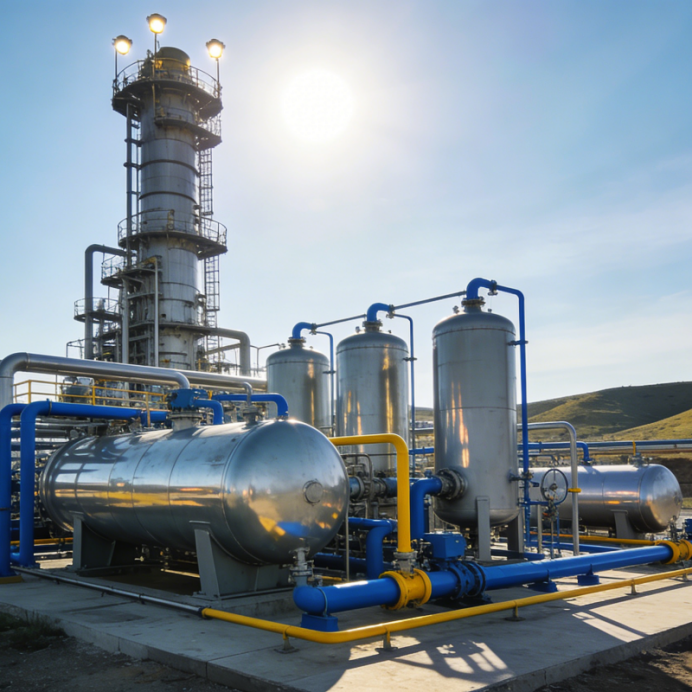
Why Filtration Is Fundamental to Natural Gas Processing Plants
Raw natural gas contains particulates, hydrocarbon liquids, and corrosive agents—including hydrogen sulfide (H₂S)—that threaten infrastructure integrity. Without multi-stage filtration, these contaminants cause equipment erosion, pipeline blockages, and accelerated corrosion, triggering unplanned shutdowns costing operators up to $500,000 per incident. Pipeline-quality specifications demand near-zero contaminant levels to protect downstream turbines, compressors, and custody-transfer measurement systems.
Effective filtration prevents:
- Safety hazards: H₂S exposure risks and flammable hydrocarbon accumulation
- Operational losses: Reduced throughput from fouled heat exchangers and inefficient separation
- Compliance failures: Emissions violations due to uncontrolled contaminant release
Filtration serves as the primary defense layer in natural gas processing plants. By removing solids down to 1 micron and coalescing sub-micron aerosols, modern systems maintain stringent gas quality while extending equipment lifespan by 30–40%. This foundational protection ensures uninterrupted production, regulatory adherence, and long-term asset integrity.
How Multi-Stage Filtration Removes Key Contaminants in Gas Streams
Natural gas processing plants rely on multi-stage filtration systems to protect critical equipment and ensure product purity. These systems combine complementary technologies in sequence—each stage targeting specific contaminants with precision.
Particulate, Aerosol, and Liquid Carryover Removal
Initial stages remove solid particulates, aerosols, and liquid entrainment using purpose-built components:
- Particulate filters capture pipeline scale, rust, and sand—typically rated between 1–40 microns
- Coalescing filters merge fine aerosol droplets into larger droplets that separate via gravity
- Liquid separators eliminate hydrocarbon carryover before gas enters compression or conditioning
This sequential removal safeguards compressors, turbines, and control valves from erosion and fouling while consistently meeting pipeline specification limits. Well-engineered multi-stage systems achieve 99.9% removal efficiency for particles ≥0.3 microns.
H₂S and Sour Gas Adsorption Using Specialty Media
Later stages target gaseous impurities like hydrogen sulfide (H₂S) using chemically selective adsorbents:
- Activated carbon beds adsorb mercaptans and volatile organic compounds (VOCs)
- Metal oxide media (e.g., iron-, zinc-, or copper-based) chemically convert H₂S into stable metal sulfides
- Molecular sieves simultaneously dehydrate gas and remove trace sulfur species
Adsorbent selection must account for sour gas concentration variability. Bed depth, gas velocity, and contaminant loading dictate design parameters—and real-time monitoring enables predictive change-out scheduling. This prevents breakthrough events that could poison catalysts in downstream amine units or sulfur recovery systems.
Selecting the Right Filter Specifications for Natural Gas Processing Plants
Micron Rating, Efficiency, and ISO Class Alignment
Micron rating defines the smallest particle a filter reliably captures; efficiency indicates the percentage removed at that size. For example, a 1-micron filter with 99.5% efficiency protects sensitive instrumentation and rotating equipment from fine solids. Aligning these metrics with internationally recognized standards—such as ISO 8573 for compressed gas purity or ISO 4406 for particulate contamination—ensures consistent, auditable gas quality across the plant.
Operators must verify that filter media can sustain expected contaminant loads without excessive pressure drop. A mismatch between micron rating and actual particle distribution leads to premature blinding or bypass flow. Therefore, reviewing site-specific gas composition and particle size distribution prior to specification is essential for reliable, long-term performance.
Balancing Adsorbent Lifespan with Real‑Time H₂S Variability
Hydrogen sulfide concentrations in raw gas can spike unpredictably—posing a challenge for fixed-bed adsorption systems. Iron-based or amine-impregnated media capture H₂S through irreversible chemical reaction or reversible physical adsorption, but their service life depends on both cumulative loading and peak exposure intensity.
Optimal design balances bed volume, regeneration frequency, and real-time adaptability. Online H₂S analyzers allow operators to modulate flow rates, activate standby beds, or initiate regeneration before breakthrough occurs. While oversizing adsorbent vessels adds capital cost, undersizing invites frequent changeouts and operational risk. The most effective approach matches adsorbent capacity to historical H₂S profiles—including transient spikes—and incorporates a calibrated safety margin to ensure continuous protection without excess media consumption.
Real-World Performance: Filtration Integration at Scale
Field data from large-scale natural gas processing plants confirm that thoughtfully integrated filtration delivers measurable improvements in reliability, cost control, and compliance.
Jonah Field Case Study: System Reliability and Uptime Gains
At the Jonah Field—one of North America’s largest natural gas processing facilities—a multi-stage filtration train was deployed to manage high particulate loads and highly variable H₂S content. Over an 18-month evaluation period, the plant achieved a 22% reduction in unscheduled maintenance events—driven primarily by consistent removal of liquid carryover and fine aerosols. Filter change intervals doubled, cutting media replacement costs by 35%. Differential pressure monitoring enabled predictive maintenance, allowing operators to replace media before performance degradation compromised pipeline-spec gas quality.
The result: mechanical uptime improved from 94% to 98.5%, yielding an estimated $1.2 million in annual avoided downtime costs.
FAQs
Why is filtration important in natural gas processing?
Filtration removes contaminants such as particulates, hydrocarbon liquids, and corrosive agents from natural gas streams. This prevents equipment erosion, ensures safety, maintains gas quality, and enhances operational efficiency.
What are the main types of filters used in natural gas processing?
The main types include particulate filters, coalescing filters, liquid separators, and specialty media such as activated carbon beds and molecular sieves for adsorbing gaseous impurities like H₂S.
How does filtration extend equipment lifespan?
Filtration prevents the accumulation of contaminants that can cause erosion and fouling, thereby extending the lifespan of turbines, compressors, and other sensitive equipment.
What factors should be considered when selecting filters for a natural gas plant?
Key factors include micron rating, efficiency, contaminant load, gas composition, and alignment with ISO standards to ensure consistent performance and quality.
What role does real-time monitoring play in filtration systems?
Real-time monitoring helps track contaminant levels, optimize filter performance, and schedule predictive maintenance to prevent system failures and breakthrough events.