 EN
EN

The Carbon Problem That Won't Go Away
Natural gas has long been marketed as the cleanest fossil fuel. And on a combustion basis, that is technically true—it produces roughly 30% to 50% less CO₂ per unit of energy than coal or oil. But "cleaner" is not the same as "clean." With global gas demand continuing to grow and LNG trade accounting for approximately 59% of total gas trade, the cumulative CO₂ emissions from natural gas processing and combustion remain substantial.
The International Energy Agency has made the math clear: without significant deployment of carbon capture, natural gas cannot be considered a low-emission energy source in the long term. The agency has also noted that LNG emissions could be reduced by over 60% using existing technologies—if the investment is made. That is a big "if," but it puts the opportunity in perspective.
For natural gas processing plants specifically, the carbon capture challenge is different from power generation or industrial sources. The CO₂ is often present in the feed gas itself, at concentrations that vary widely depending on the reservoir. Removing it is already part of the gas treatment scope—the question is whether to capture it for sequestration rather than venting it to atmosphere.
The Technologies That Actually Get Used
Amine-based chemical absorption remains the dominant technology for CO₂ capture in natural gas applications. It is mature, well understood, and capable of high capture rates. The basic principle is straightforward: an amine solvent contacts the gas stream in an absorber column, selectively reacting with CO₂ to form a weak chemical bond. The rich solvent then flows to a regenerator, where heat breaks the bond and releases a concentrated CO₂ stream.
The challenge is energy consumption. The regeneration step requires significant heat, typically supplied as low-pressure steam from the plant's utility system. This heat duty is the primary operating cost for amine systems and the main reason the technology has an energy penalty that some operators find hard to justify.
Membrane technology is gaining traction as an alternative or complement to amine scrubbing. Polymeric membranes can selectively permeate CO₂ over methane, providing bulk removal with lower energy consumption. Hollow fiber membrane contactors combined with amine solvents have been demonstrated to achieve roughly 30% lower operating costs than conventional systems, with a footprint up to 50% smaller.
Each approach has its sweet spot. Amine systems excel when high capture rates and high product purity are required. Membranes are attractive for bulk CO₂ removal where moderate purity is acceptable and energy costs are a primary concern. Hybrid systems that combine both technologies are also emerging, using membranes for rough separation and amines for polishing.
Where Carbon Capture Makes Sense in the Gas Plant
Not every natural gas processing facility is a good candidate for carbon capture. The economics depend heavily on the CO₂ content of the feed gas, the availability of a sequestration or utilization pathway, and the regulatory or incentive environment.
Facilities processing gas from reservoirs with high CO₂ content—sometimes 10% to 20% or more—have the most straightforward case. The CO₂ is already being removed for pipeline specification; capturing it for sequestration adds incremental cost but may be justified by carbon pricing or tax credits. In the United States, for example, the Department of Energy has opened substantial funding for carbon capture projects at natural gas facilities, targeting 90% capture rates.
For plants with low CO₂ content, the economics are more challenging. The incremental cost of capture per tonne of CO₂ is higher because the gas flow is larger relative to the CO₂ removed. These facilities may need to rely on policy support or carbon credit revenue to make the numbers work.
There is also the question of what to do with the captured CO₂. Enhanced oil recovery has been the traditional outlet, with the CO₂ injected into depleted reservoirs to boost production. Storage in saline aquifers is another option, though it requires careful site characterization and monitoring. Utilization pathways—converting CO₂ into chemicals, fuels, or building materials—are emerging but remain small in scale.
A First-of-Its-Kind Project Worth Noting
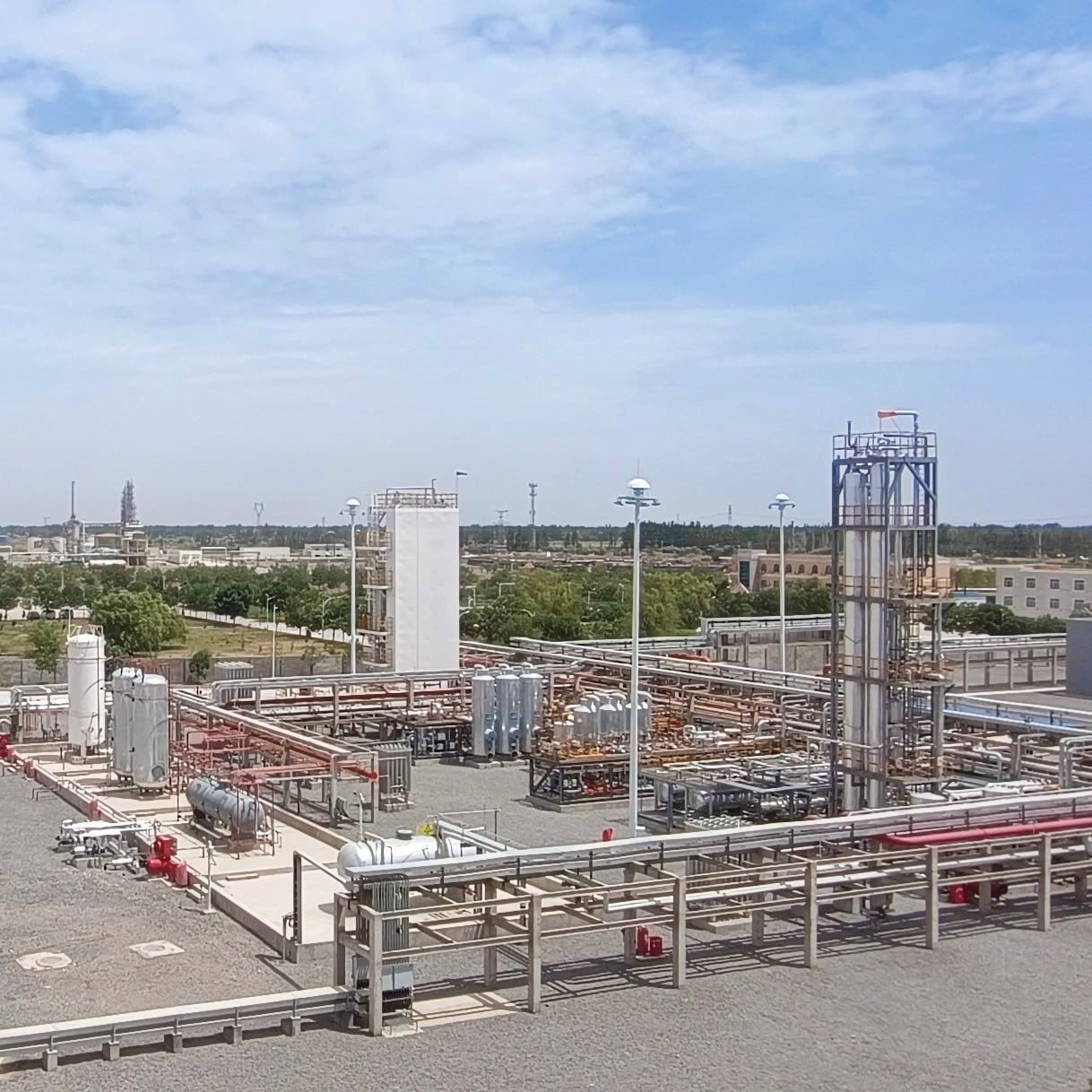
A recently commissioned project in southwest China provides an instructive example. The facility is a natural gas purification plant that processes sour gas from a nearby field. The carbon capture unit was added as a demonstration project to prove the technical and economic viability of capturing CO₂ from the plant's tail gas.
The project uses a chemical absorption process with a proprietary amine formulation optimized for the low-pressure, medium-concentration CO₂ stream characteristic of the plant's tail gas. The design incorporates a water wash section above the absorber to minimize amine carryover, combined with a micro-cyclone separation stage to recover entrained solvent.
The captured CO₂ is compressed and injected back into the same gas field for enhanced gas recovery. This creates a closed-loop system where the CO₂ serves a productive purpose while being kept out of the atmosphere. The annual capture capacity is approximately 26,500 tonnes, and the enhanced recovery effect is reported to increase production by roughly 10%.
The project is significant not because of its scale—there are larger carbon capture facilities elsewhere—but because it demonstrates integration of capture with enhanced gas recovery in a natural gas processing context. The technical approach, the solvent selection, and the injection strategy all had to be developed specifically for this application, and the lessons learned are being applied to subsequent projects.
The Real Costs and Trade-Offs
Honest discussion of carbon capture requires acknowledging the costs and trade-offs. The energy penalty is real. Amine regeneration consumes steam that could otherwise generate power or serve other process needs. This parasitic load reduces the net output of the facility or increases its fuel consumption.
| Technology | Capture Rate | Energy Penalty | Footprint | Maturity | |
|---|---|---|---|---|---|
| Amine scrubbing | High (90%+) | Significant | Large | Mature | |
| Membrane separation | Moderate | Lower | Compact | Developing | |
| Hybrid membrane-amine | High | Moderate | Moderate | Emerging |
The table above summarizes the key trade-offs. Amine systems deliver the highest capture rates but at the highest energy cost. Membrane systems are more efficient but typically cannot achieve the same capture rates without multi-stage configurations. Hybrid approaches attempt to capture the best of both but are less proven at commercial scale.
There are also operational considerations. Amine degradation over time requires solvent reclaiming and replacement. Membrane fouling and aging affect performance and require periodic replacement. The integrity of the CO₂ stream for transport and storage must be maintained—contaminants like water, oxygen, and sulfur compounds can cause corrosion or affect injectivity.
The economics depend heavily on external factors. Carbon pricing, tax credits, and regulatory mandates can make a marginal project viable. Without such support, only the highest-CO₂ facilities or those with favorable EOR arrangements can justify the investment.
The Policy Landscape and What It Means
The policy environment is shifting. The IEA has identified CCUS as a critical technology for decarbonizing the gas value chain. Government funding programs are emerging in multiple jurisdictions. The U.S. DOE has made billions available for carbon capture demonstration and deployment. Similar initiatives exist in Europe, Asia, and the Middle East.
But policy support is not a given. Funding can be withdrawn, tax credits can expire, and regulatory requirements can change. Project developers must assess not just the technical and economic feasibility but also the policy risk. Some projects are proceeding with a "capture-ready" design that allows for future addition of capture equipment, deferring the capital investment until the policy and economic case is clearer.
The technology itself continues to evolve. New solvent formulations promise lower regeneration energy. Advanced membrane materials offer higher selectivity and durability. Process integration strategies—using waste heat for regeneration, optimizing the capture train for the specific gas composition—can improve overall efficiency.
For natural gas plant operators, the decision to add carbon capture is not straightforward. It requires a careful assessment of feed gas composition, available utilities, sequestration options, policy support, and market conditions. The projects that succeed are those that match the technology to the specific site conditions and have a clear path to commercialization.
GreenFir provides gas treatment and separation equipment that can be configured to support carbon capture integration, backed by fabrication capabilities with ASME and CE certifications. The equipment supply chain exists; the engineering expertise is available. The limiting factor is often the project-level economics and the policy environment rather than the technology itself.