 EN
EN

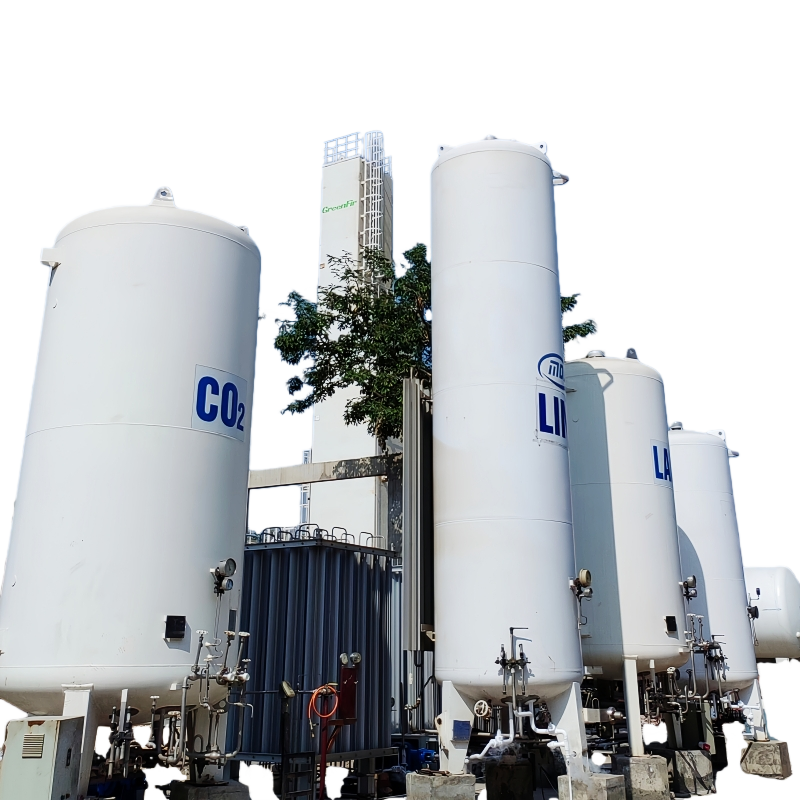
How Liquid Air Separation Units Work: The Cryogenic Distillation Process
Liquefaction and Boiling Point Differentiation: Separating Nitrogen, Oxygen, and Argon
The process of cryogenic distillation works by separating nitrogen, oxygen, and argon based on how each gas boils at different temperatures. First, regular air gets compressed to around 6 bar pressure and then chilled down to roughly -175 degrees Celsius until it turns into liquid form ready for separation. When heated again, nitrogen starts to boil off first at about -195.8 degrees Celsius, then comes argon at -185.9 degrees Celsius, leaving oxygen last at -183 degrees Celsius. There's actually a pretty important 13 degree gap between when nitrogen and oxygen separate, which makes all the difference in getting clean results from distillation towers. Because of this careful temperature control, today's Air Separation Units (ASUs) can reliably produce oxygen and nitrogen with purity levels over 99.5%, while recovering more than 95% of available argon in the process.
Why Liquid Air Is the Essential Feedstock — Thermodynamics and Energy Integration
Liquid air acts as the essential starting material for big ASU operations, not just because it's convenient but because of how it works thermodynamically. When we liquefy air, we're basically shrinking its volume around 700 times over, which means we can store it in smaller spaces, transfer heat more effectively, and keep those distillation columns running smoothly. Sure, compressing stuff takes a lot of energy, but smart systems have been developed to reclaim some of that cold from products like liquid oxygen and nitrogen streams. This helps cut down overall energy needs somewhere between 30% and maybe even 40%. Because of these efficiencies, cryogenic distillation remains the go-to approach for really large scale operations above about 100 tons per day, since other methods such as membranes or PSA simply can't match either the output levels or the purity standards required. Look at it this way: plants making up to 5,000Nm³/h of oxygen can actually fit comfortably on half an acre of land, something that would be impossible with alternative technologies.
Core Process Stages of Air Separation Units
Compression and Purification: Removing CO₂, Moisture, and Hydrocarbons to Prevent Freeze-Out
ASUs begin by compressing ambient air to ~150 psia (≅10 bar), raising its density for effective downstream processing. This pressurized air then passes through a multi-stage purification train designed to remove contaminants that would freeze or react at cryogenic temperatures:
- Particulate filters eliminate dust and mechanical debris
- Coalescing filters remove oil aerosols from compressor lubricants
- Adsorption beds containing activated alumina and zeolites absorb moisture and CO₂
This staged approach prevents ice formation in heat exchangers and eliminates acetylene accumulation—a known explosion hazard in oxygen-rich environments. Proper purification extends molecular sieve service life by 30–40%, significantly lowering lifecycle maintenance costs.
Cooling, Expansion, and Fractionation: From Gaseous Air to High-Purity Liquid Products
After purification, air enters the cryogenic section, where it's cooled to ~°185°C via counterflow heat exchange in brazed aluminum plate-fin exchangers. A portion undergoes controlled expansion through turbines, leveraging the Joule-Thomson effect to induce partial liquefaction. The resulting two-phase mixture feeds into a dual-column distillation system:
| Gas | Boiling Point (°C) | Role in Fractionation |
|---|---|---|
| Nitrogen | °195.8 | Rises as vapor; drawn off top of upper column |
| Argon | °185.9 | Concentrated in middle of lower column; extracted for secondary refining |
| Oxygen | °183.0 | Accumulates as liquid in bottom of lower column |
Continuous condensation and reboiling cycles separate components with precision. Energy recovery during expansion recaptures 65–75% of compression energy—making the process both thermodynamically sound and operationally sustainable.
Key Industrial Applications of Air Separation Units
Heavy Industry Demand: Steelmaking, Chemical Synthesis, and Refining with Gaseous and Liquid Oxygen/Nitrogen
Air Separation Units (ASUs) deliver both gaseous and liquid forms of oxygen and nitrogen to many core industries across manufacturing. Take steel production for example. When manufacturers inject oxygen directly into blast furnaces or basic oxygen furnaces, they get better combustion results. This typically cuts down on coke usage somewhere between 20 to 30 percent and also brings down carbon dioxide emissions per ton of steel produced. For chemical processes that need protection from oxygen contamination, liquid nitrogen plays a critical role. Ethylene oxide production comes to mind here since even tiny traces of oxygen could lead to dangerous decomposition reactions. Refineries benefit too when working with high purity oxygen at around 99.5% or above. Such purity levels boost catalytic cracking processes and help maintain effective hydrodesulfurization without worrying about catalysts getting deactivated over time. The liquid form advantage extends beyond just performance though. Because liquids pack more energy into smaller volumes and offer greater logistical options, companies integrating ASUs into their operations often see transportation costs drop by roughly 40% compared to relying solely on pipelines for gas delivery.
High-Purity Niche Applications: Medical Oxygen, Modified Atmosphere Packaging, and Semiconductor Manufacturing
Air separation units do much more than just produce large volumes of gas. They actually create ultra pure gases that are vital for some really important applications. Take medical grade oxygen for instance. It needs to be at least 99.5% pure according to USP/EP standards and is absolutely critical for patients needing respiratory support or those in intensive care units. Demand shot up by around 25% during the last major health crisis. The food industry also relies heavily on nitrogen's properties. When packaged foods are kept in modified atmosphere packaging (MAP), the nitrogen prevents spoilage by stopping oxidation and microbial growth. This helps extend shelf life significantly and cuts down on the roughly 30% food waste problem across the sector. And then there's semiconductor manufacturing where things get even more exacting. For these operations, nitrogen must reach purity levels of 99.999% (known as 5N purity) with oxygen contamination staying under 1 part per million. Cryogenic distillation remains the only method capable of achieving such precision, which makes all the difference when producing flawless silicon wafers.
Design and Reliability in Modern Air Separation Units
ASUs today are built to run non-stop even when things get tough in industrial environments. The systems have backup compressors and special control mechanisms that keep those super cold columns right around plus or minus half a degree Celsius. This temperature stability matters a lot because it makes sure the separation process works properly and keeps the final products clean and pure. For structural strength, manufacturers use these double-layered tanks with vacuum insulation made from special steel alloys that won't crack or wear out even at minus 196 degrees. When it comes to saving energy, modern ASUs actually recycle heat from compression parts, cutting down on power needs by about 15 to 20 percent compared to older models. Research published in journals like the Journal of Cleaner Production back this up. Another smart feature is modular design, which lets plants expand their capacity step by step and replace components while still running operations. All these thoughtful engineering choices result in about 99.6% uptime, meaning hospitals, semiconductor factories, and other essential facilities can count on steady supplies of liquid nitrogen, oxygen, and argon whenever they need them.
FAQ
-
How does cryogenic distillation work?
Cryogenic distillation works by cooling compressed air into a liquid state and then heating it to separate gases based on their boiling points. -
What are some industrial applications for purified gases from ASUs?
Purified gases are used in steelmaking, chemical synthesis, refining, medical fields, modified atmosphere packaging, and semiconductor manufacturing. -
What is the significance of modular design in modern ASUs?
Modular design allows for capacity expansion and component replacement without halting operations, enhancing efficiency and reliability. -
Why is oxygen purity important in industrial applications?
High oxygen purity is crucial for processes like catalytic cracking and avoiding catalyst deactivation in refineries. -
What are the main gases separated in Air Separation Units (ASUs)?
Nitrogen, oxygen, and argon are the primary gases separated in ASUs.